The Mexica made reference to at least two manifestations of the supernatural: tēōtland tēixiptla. Tēōtl, which the Spaniards and European scholars routinely mistranslated as "god" or "demon", referred rather to an impersonal force that permeated the world. Tēixiptla, by contrast, denoted the physical representations ("idols", statues and figurines) of the tēōtl as well as the human cultic activity surrounding this physical representation. The Mexica "gods" themselves had no existence as distinct entities apart from these tēixiptla representations of tēōtl.

Veneration of Huitzilopochtli, the personification of the sun and of war, was central to the religious, social and political practices of the Mexicas. Huitzilopochtli attained this central position after the founding of Tenochtitlan and the formation of the Mexica city-state society in the 14th century. Prior to this, Huitzilopochtli was associated primarily with hunting, presumably one of the important subsistence activities of the itinerant bands that would eventually become the Mexica.
According to myth, Huitzilopochtli directed the wanderers to found a city on the site where they would see an eagle devouring a snake perched on a fruit-bearing nopalcactus. (It was said that Huitzilopochtli killed his nephew, Cópil, and threw his heart on the lake. Huitzilopochtli honoured Cópil by causing a cactus to grow over Cópil's heart.) Legend has it that this is the site on which the Mexicas built their capital city of Tenochtitlan. This legendary vision is pictured on the Coat of arms of Mexico.
According to their own history, when the Mexicas arrived in the Anahuac valley (Valley of Mexico) around Lake Texcoco, the groups living there considered them uncivilized. The Mexicas borrowed much of their culture from the ancient Toltecwhom they seem to have at least partially confused with the more ancient civilization of Teotihuacan. To the Mexicas, the Toltecs were the originators of all culture; "Toltecayōtl" was a synonym for culture. Mexica legends identify the Toltecs and the cult of Quetzalcoatl with the mythical city of Tollan, which they also identified with the more ancient Teotihuacan.
As all other Mesoamerican cultures, the Aztecs played a variant of theMesoamerican ballgame, named tlachtli or ollamaliztli in Nahuatl. The game was played with a ball of solid rubber, called an olli, whence derives the Spanish word for rubber, hule. The players hit the ball with their hips, knees, and elbows and had to pass the ball through a stone ring to automatically win. The practice of the ballgame carried religious and mythological meanings and also served as sport.
Human sacrifice
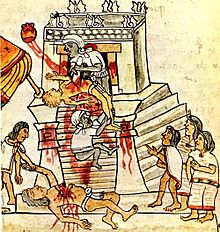
While human sacrifice was practiced throughout Mesoamerica, the Aztecs, if their own accounts are to be believed, brought this practice to an unprecedented level. For example, for the reconsecration of the Great Pyramid of Tenochtitlan in 1487, the Aztecs reported that they sacrificed 80,400 prisoners over the course of four days, reportedly by Ahuitzotl, the Great Speaker himself. This number, however, is not universally accepted.
Accounts by the Tlaxcaltecas, the primary enemy of the Aztecs at the time of the Spanish Conquest, show that at least some of them considered it an honor to be sacrificed. In one legend, the warrior Tlahuicole was freed by the Aztecs but eventually returned of his own volition to die in ritual sacrifice. Tlaxcala also practiced the human sacrifice of captured Aztec Citizens.
CHECK THIS VIDEO IS VERY INTERESTING!!!

I like the information in my opinion its interesting because talk about aztec culture
ResponderEliminarI like this part, I think is there most interesting, and it mentioned things that I didn't know! :)
ResponderEliminarThe Human sacrifice really go my atention I mean How humans could do that? It's shocking but well it was long time ago, and the Mythology was interesting as well.
ResponderEliminarthe documentary tells you what you need to know, girls good job
!
All the information is complete and interesting but what I like the most was this part,I think that know more about their religion and the mytologhy can help us to understand all their beliefs. As I said all the information you put is important and can help us to study for the exam. Andrea
ResponderEliminarThis information is interesting. I like the myth they had. The human sacrifice is kinda surpresive. That video is so interesting, i like it! Nice blog! (:
ResponderEliminarI did not know all that about the sacrifices, so thank you very much for the information, is well explained and the video is perfect !!!!
ResponderEliminar