miércoles, 6 de abril de 2016

Spanish conquest
The empire reached its height during Ahuitzotl's reign in 1486–1502. His successor, Motehcuzōma Xocoyotzin (better known as Moctezuma II or Moctezuma, or Montezuma), had been Hueyi Tlatoani for 17 years when the Spaniards, led byHernándo Cortés, landed on the Gulf Coast in the spring of 1519.
Despite some early battles between the two, Cortés allied himself with the Aztecs’ long-time enemy, the Confederacy of Tlaxcala, and arrived at the gates ofTenochtitlan on November 8, 1519.
The Spaniards and their Tlaxcallan allies became increasingly dangerous and unwelcome guests in the capital city. In June 1520, hostilities broke out, culminating in the massacre in the Great Temple and the death of Moctezuma II. The Spaniards fled the town on July 1, an episode later characterized as La Noche Triste (the Sad Night). They and their native allies returned in the spring of 1521 to lay siege to Tenochtitlan, a battle that ended on August 13 with the destruction of the city. During this period the now crumbling empire went through a rapid line of ruler succession. After the death of Moctezuma II, the empire fell into the hands of severely weakened emperors, such as Cuitláhuac, before eventually being ruled by puppet rulers, such as Andrés de Tapia Motelchiuh, installed by the Spanish.

Despite the decline of the Aztec empire, most of the Mesoamerican cultures were intact after the fall of Tenochtitlan. Indeed, the freedom from Aztec domination may have been considered a positive development by most of the other cultures. The upper classes of the Aztec empire were considered noblemen by the Spaniards and generally treated as such initially. All this changed rapidly and the native population were soon forbidden to study by law, and had the status of minors.
The Tlaxcalans remained loyal to their Spanish friends and were allowed to come on other conquests with Cortés and his men.

Mythology and religion
The Mexica made reference to at least two manifestations of the supernatural: tēōtland tēixiptla. Tēōtl, which the Spaniards and European scholars routinely mistranslated as "god" or "demon", referred rather to an impersonal force that permeated the world. Tēixiptla, by contrast, denoted the physical representations ("idols", statues and figurines) of the tēōtl as well as the human cultic activity surrounding this physical representation. The Mexica "gods" themselves had no existence as distinct entities apart from these tēixiptla representations of tēōtl.

Veneration of Huitzilopochtli, the personification of the sun and of war, was central to the religious, social and political practices of the Mexicas. Huitzilopochtli attained this central position after the founding of Tenochtitlan and the formation of the Mexica city-state society in the 14th century. Prior to this, Huitzilopochtli was associated primarily with hunting, presumably one of the important subsistence activities of the itinerant bands that would eventually become the Mexica.
According to myth, Huitzilopochtli directed the wanderers to found a city on the site where they would see an eagle devouring a snake perched on a fruit-bearing nopalcactus. (It was said that Huitzilopochtli killed his nephew, Cópil, and threw his heart on the lake. Huitzilopochtli honoured Cópil by causing a cactus to grow over Cópil's heart.) Legend has it that this is the site on which the Mexicas built their capital city of Tenochtitlan. This legendary vision is pictured on the Coat of arms of Mexico.
According to their own history, when the Mexicas arrived in the Anahuac valley (Valley of Mexico) around Lake Texcoco, the groups living there considered them uncivilized. The Mexicas borrowed much of their culture from the ancient Toltecwhom they seem to have at least partially confused with the more ancient civilization of Teotihuacan. To the Mexicas, the Toltecs were the originators of all culture; "Toltecayōtl" was a synonym for culture. Mexica legends identify the Toltecs and the cult of Quetzalcoatl with the mythical city of Tollan, which they also identified with the more ancient Teotihuacan.
As all other Mesoamerican cultures, the Aztecs played a variant of theMesoamerican ballgame, named tlachtli or ollamaliztli in Nahuatl. The game was played with a ball of solid rubber, called an olli, whence derives the Spanish word for rubber, hule. The players hit the ball with their hips, knees, and elbows and had to pass the ball through a stone ring to automatically win. The practice of the ballgame carried religious and mythological meanings and also served as sport.
Human sacrifice
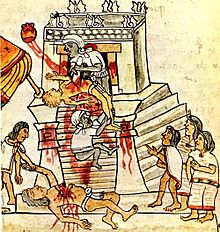
While human sacrifice was practiced throughout Mesoamerica, the Aztecs, if their own accounts are to be believed, brought this practice to an unprecedented level. For example, for the reconsecration of the Great Pyramid of Tenochtitlan in 1487, the Aztecs reported that they sacrificed 80,400 prisoners over the course of four days, reportedly by Ahuitzotl, the Great Speaker himself. This number, however, is not universally accepted.
Accounts by the Tlaxcaltecas, the primary enemy of the Aztecs at the time of the Spanish Conquest, show that at least some of them considered it an honor to be sacrificed. In one legend, the warrior Tlahuicole was freed by the Aztecs but eventually returned of his own volition to die in ritual sacrifice. Tlaxcala also practiced the human sacrifice of captured Aztec Citizens.
CHECK THIS VIDEO IS VERY INTERESTING!!!
National Geographic The Aztecs Empire Documentary
INTRODUCTION
The Aztec people were certain ethnic groups of central Mexico, particularly those groups who spoke the Nahuatl language and who dominated large parts of Mesoamerica from the 14th to 16th centuries. The Nahuatl words aztecat and aztecah mean "people fromAztlan",a mythological place for the Nahuatl-speaking culture of the time, and later adopted as the word to define the Mexica people. Often the term "Aztec" refers exclusively to the Mexica people of Tenochtitlan (now the location of Mexico City), situated on an island in Lake Texcoco, who referred to themselves as Mēxihcah Tenochcah or Cōlhuah Mexihcah
Sometimes the term also includes the inhabitants of Tenochtitlan's two principal allied city-states, the Acolhuas of Texcoco and the Tepanecs of Tlacopan, who together with the Mexica formed the Aztec Triple Alliance that controlled what is often known as the "Aztec Empire". In other contexts, Aztec may refer to all the various city states and their peoples, who shared large parts of their ethnic history and cultural traits with the Mexica, Acolhua and Tepanecs, and who often also used the Nahuatl language as a lingua franca. In this meaning it is possible to talk about an Aztec civilization including all the particular cultural patterns common for most of the peoples inhabiting Central Mexico in the late postclassic period.
From the 13th century, the Valley of Mexico was the heart of Aztec civilization: here the capital of the Aztec Triple Alliance, the city of Tenochtitlan, was built upon raised islets in Lake Texcoco. The Triple Alliance formed a tributary empire expanding its political hegemony far beyond the Valley of Mexico, conquering other city statesthroughout Mesoamerica. At its pinnacle, Aztec culture had rich and complexmythological and religious traditions, as well as achieving remarkable architectural and artistic accomplishments. In 1521 Hernán Cortés, along with a large number of Nahuatl speaking indigenous allies, conquered Tenochtitlan and defeated the Aztec Triple Alliance under the leadership of Hueyi Tlatoani Moctezuma II. Subsequently the Spanish founded the new settlement of Mexico City on the site of the ruined Aztec capital, from where they proceeded with the process of colonizing Central America.
Aztec culture and history is primarily known through archaeological evidence found in excavations such as that of the renowned Templo Mayor in Mexico City; fromindigenous bark paper codices; from eyewitness accounts by Spanish conquistadors such as Hernán Cortés and Bernal Díaz del Castillo; and especially from 16th and 17th century descriptions of Aztec culture and history written by Spanish clergymen and literate Aztecs in the Spanish or Nahuatl language, such as the famousFlorentine Codex compiled by the Franciscan monk Bernardino de Sahagún with the help of indigenous Aztec informants.

Suscribirse a:
Entradas (Atom)